Sometimes the need differs from standardized methods, and well… If something is ought to be standardized, it doesn’t hurt for it to exist first. Below is a surface resistance bar electrode (SRB), which is an alternative approach to using the concentric ring electrode. More of the reasons may be read from this publication in more detail. Note, it is behind a small paywall.

The smaller handheld electrodes are designed to enable measurement of more complex test environments, e.g., directly on a conveyor belt and parts with no well-defined areas for proper placement of a bulkier electrode. In you’re not aware of what you’re looking for, get in touch via contact form and we’ll see if we’ve got something ready, in case not, then we’ll provide you a feasibility check including estimate for cost and lead time to get something tailored.
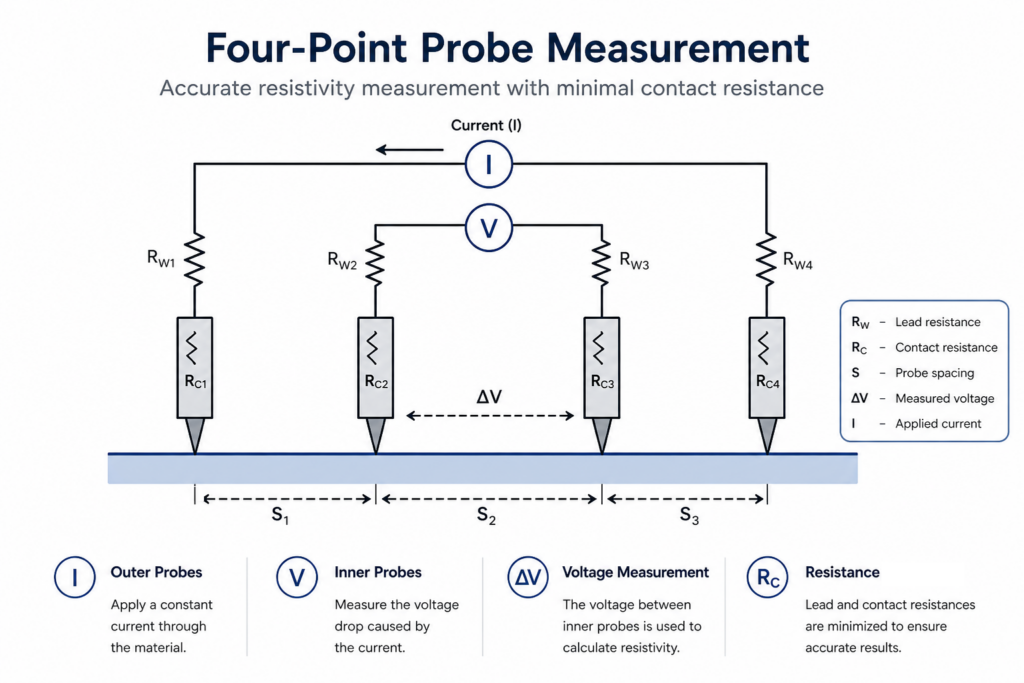
Standard 4-point methods
There are two well established, methods for 4-point volume resistivity measurement of conductive plastics, here is a short comparison of them.
- Current electrodes are on both sides of the sample, aligned and connected with a jumper wiring.
- Load between the current electrodes is varied according to the sample width, which is defined as 1 to 15 cm. The applied force is 300 N/m.
- Pointy voltage electrodes are on the bottom side of the sample. Applied force is 60 N/m.
- More streamlined measurement process.
- Sample is fixed to outer electrodes with more leeway in design, not necessarily from both sides.
- Current electrode load is not specified, while the voltage sensing system mass is defined to exert roughly a force of 0,6 N on the sample across the span of 10 ± 0,2 mm.
- More complicated sampling process.
In case none of these are what you’re looking for, get in touch via contact form and we’ll see if we’ve got something ready, in case not, then you will get a feasibility check including estimate for cost and lead time.